Author: paulwilliamatkinson
Join us and help bring new life to the Network
A message from the new steering group forming after the FPN meeting on 27th September
Dear all,
It was lovely to see those of us who were able to attend the Zoom meeting on Sept 27th about the future of FPN – some new faces, and some familiar.
There certainly seems to be an appetite for keeping the FPN directory going as a valuable resource for clients wanting to access ‘proper therapy’ but without the means to pay our usual rates, and for finding ways to expand this to better meet the needs of our communities. There was also some appetite for reviving FPN as a conduit for campaigning as it was when it first began more than 10 years ago, and for opening up the support we provide for one another, perhaps through local groups, or peer supervision.
Paul, Nicola, Andy and Andrea, who started us off in 2014, will remain involved and listed on the directory, but are ready to begin to hand over the reins as they turn their attentions toward other things – so we’re putting a call out for anyone who’d be interested in being part of a new Steering Group to take us forward. There’s no requirement for any major time commitment from anyone stepping forward: just a will to keep FPN going, and some capacity for a degree of practical involvement.
If you’d be open to exploring playing a part in this, just get in touch on the FPN email at freepsynetwork@gmail.com We’ll then get everyone together to consider what needs doing now, what we might like to do in the short and longer term futures, and how we’re going to make it all happen. Don’t be intimidated – we’re all plenty busy, I know. Let’s find a way to shape it so FPN serves us, and continues to be valuable as a resource for clients and a network for therapists.
Many thanks,
Marsha, Darya, Harriet
Albatross Collective: a network of radical clinicians offering psychotherapy and psychoanalysis to people on the left
Dear FPN,
We are writing to let you know that a radical psychotherapy group I’m part of has just launched its website and three new initiatives. We’d be grateful if you could share the below with Free Psychotherapy Network colleagues and through other networks.
The Albatross Collective is a London-based collective of psychotherapists, psychoanalysts and clinical psychologists. We are working to develop ways of doing psychotherapy and psychoanalysis that are accessible, liberatory and that support social action.
The collective coordinates the Albatross Clinic, a network of radical clinicians offering psychotherapy and psychoanalysis to people on the left. People looking for a therapist or analyst can write to albatrossclinic@protonmail.com to enquire about an initial consultation with a network member or find out more here.
The Albatross Collective also supports groups and community organisations by holding space for members to think and feel together about difficult experiences. Contact us at albatrosscollective@protonmail.com to discuss support for your group or find out more here.
Finally, in 2025/26 we are working with Cooperation Town to pilot a free social action psychotherapy project for council estate residents in Gospel Oak. More information about this will be available on our website soon.
You can also follow us on Instagram: @albatross_collective
Please share far and wide!
Albatross Collective
New radical psychotherapy initiative
Dear FPN members and friends,
I’m writing to let you know that a radical psychotherapy group I’m part of has just launched its website and three new initiatives. We’d be grateful if you could share the below with Free Psychotherapy Network colleagues and through other networks.
The Albatross Collective is a London-based collective of psychotherapists, psychoanalysts and clinical psychologists. We are working to develop ways of doing psychotherapy and psychoanalysis that are accessible, liberatory and that support social action.
The collective coordinates the Albatross Clinic, a network of radical clinicians offering psychotherapy and psychoanalysis to people on the left. People looking for a therapist or analyst can write to albatrossclinic@protonmail.com to enquire about an initial consultation with a network member or find out more here.
The Albatross Collective also supports groups and community organisations by holding space for members to think and feel together about difficult experiences. Contact us at albatrosscollective@protonmail.com to discuss support for your group or find out more here.
Finally, in 2025/26 we are working with Cooperation Town to pilot a free social action psychotherapy project for council estate residents in Gospel Oak. More information about this will be available on our website soon.
You can also follow us on Instagram: @albatross_collective
Please share far and wide!
Time for change at FPN
Dear FPN colleagues and friends,
I am writing to let you know that I am thinking about stepping back from the administration of FPN in the near future. We are now over 10 years old. After the early years of energy as a political venture combining the provision of free counselling and therapy for people on benefits/low incomes with activism around social inequality and the abuse of counselling and psychotherapy in the service of capitalist agendas, FPN as an organisation has become exclusively focussed on providing free and very low cost therapy. This is as important a project as ever.
We still have new therapists joining us as well as leaving the list. Overall the number of therapists has changed little – around 80. A lot of us now have notices under our entry saying we have no vacancies. Though the number of visits to the websites has fallen from a peak in 2021, we still have 50,000 visits and around 25,000 unique visitors a year.
For several years FPN has been run by a small group of therapists, based in London. Some of us are getting old (me for example) and/or are committed to a range of political campaigns including other projects around therapy and politics.
I think FPN needs a new lease of life with new people interested in organising it, revisioning its identity and mission. I am happy to help see a transition through. At the same time, I will be stepping back over the next year.
Nicola Saunders, Andy Metcalf and I met recently to discuss the issue and decided to call a general meeting on 27th September of FPN therapists, supporters, and anyone interested in the project to talk about where we go from here. Hopefully, ideas and energy committed to revitalising and keeping FPN alive will come out of that meeting. If not, we may have to think about how to responsibly close the project.
One of the issues is how few general meetings of members and friends we have managed to host in the past few years. As a consequence, we have lost touch with how much energy and passion people in the Network have for the project. We are writing to some of you whose active participation we are aware of to ask for your thoughts on FPN’s future and to help prepare for a general meeting in September. Could you please give this some thought over the next few weeks and come back to me with your responses. We will be sending out notice of the September meeting during July.
All good wishes for the Summer.
Paul Atkinson
paulwilliamatkinson@gmail.com
Statement from Partners for Counselling & Psychotherapy (PCP), 13th October 2022.
On Monday 10th October 2022, World Mental Health Day, the Government announced £122 million of funding for mental health. But the bitter reality is that this money is not being spent on in-patient beds, community mental health initiatives or trained counsellors and psychotherapists for public mental health services. Instead the Government is using this money to recruit and train 700 ‘employment advisers’ to work alongside therapists in the NHS’s flagship Improving Access to Psychological Therapies (IAPT) programme. This will help drive the highly contested policy of ‘welfare conditionality’ that threatens benefits claimants with sanctions if they don’t conform to certain patterns of behaviour, a policy which targets the poorest and most deserving sections of our society at a time when they need the greatest help.
Despite the timing of the press release, the money announced is not being used to build mental health support. Instead it is an expansion of an existing IAPT-based scheme providing, as the announcement states, ‘combined psychological treatment and employment support to help [people] to remain in, return to or find work and improve their mental health’ {1]. The linking of work and mental health, however, is deeply problematic. In 2015, hundreds of counsellors, psychotherapists and academics opposed the pilot scheme that first put together Jobcentre employment advisors and IAPT therapists, a scheme that in a letter to the Guardian [2] the signatories denounced as anti-therapeutic and professionally unethical.
Nothing has changed except that this policy now threatens to coerce a greater number of people into a system of employability interventions and psychological treatment in order to avoid sanctions on their welfare payments, including the main disability grants. As the highly contested Universal Credit programme is rolled out across the UK in response to rapidly growing low pay and job insecurity, many more people will be unable to secure living wages and will be forced into the benefits regime, where they will be subject to this pressure to undergo combined psychological interventions and employment advice.
What is the role of therapists in such a system? For us, work is not a health outcome. Employment is not an expected or even inherently desirable result of genuine counselling and psychotherapy. Real therapy does not aim to return individuals to the workplace or to keep them in jobs that may be economically insecure, psychologically toxic, systemically oppressive and personally damaging.
The linking of State therapy and employment advice, particularly if connected in any way with a punitive benefits system that has the power to sanction claimants for their perceived failures to find work, must surely contaminate some of the central tenets of good therapy – not least the autonomy and right to self- determination of the person undertaking it. The rolled-out scheme may be trailed as ‘voluntary’ but if ‘employment advisers and therapists will work together so that a person can return to or find work easier and faster’, as the Government say, then the non-coercive integrity of the therapy cannot realistically be maintained.
Given that the Government statement is at pains to point out how the overall aim of the project is ‘driving economic growth’, we also have to ask therapists whether they can – ethically and in good faith – align their practices with such an agenda. The therapist’s job is not to work from an assumption that ‘work is good’ or to aim to reduce the number of people receiving benefits, including disability benefits that are increasingly claimed on the basis of mental illness, but to provide an opportunity for reflection on all aspects of a person’s life.
As a network of organisations representing counsellors and psychotherapists, we at PCP believe that this announcement on World Mental Health Day is a cynical attempt to reduce government spending at the expense of people who most need genuine therapeutic support during an unprecedented period of economic crisis. We reject the financial logic that underpins the linking of employment and wellbeing services as it is a profound attack on the principles of talking therapies and will lead to a cruel and measurable deepening of the UK’s mental health crisis.
- https://www.gov.uk/government/news/122-million-employment-boost-for-people-receiving-mental-health-support
- https://www.theguardian.com/society/2015/apr/17/austerity-and-a-malign-benefits-regime-are-profoundly-damaging-mental-health
Partners for Counselling & Psychotherapy
http://www.partnersforcounsellingandpsychotherapy.co.uk
email: admin@partnersforcounsellingandpsychotherapy.co.uk
twitter: @pcp_uk #workcure #psychocompulsion
Becoming A Part Of Free Psychotherapy Network
I became part of Free Psychotherapy Network in January 2021.
I am comfortable with being paid a reasonable wage for my work and am utterly against the pressure on trained counsellors to work without pay in organisations with paid staff. I recognise and value all the training and experience that has gone into making me what I am in the therapeutic space.
However, I have always believed in the importance of there being high quality services in the care sector that are free at the point of delivery, and I have worked in those services most of my adult life. So coming across FPN was like a breath of fresh air.
Since January I have delivered over 100 hours of free person-centred therapy, and I have loved it. I love working as a therapist anyway, but I have found something special in my FPN experience. I wouldn’t be able to give large sums to charity in the way that I would wish to, but through the simple gift of my time I can give more than I would have imagined, and I can see the benefit of it too in the lives of the diverse group of people I work with.
Firstly, I was glad to be done with sliding scales and the agonising bartering with someone to ascertain what they can afford. It feels like an intrusion and a threat for them, and only adds to the power that I wield from my side of the room. People come to FPN knowing exactly how it is – they are asking for free counselling and the counsellors are looking to offer it. Hooray for a lack of ambiguity!
Secondly, I have found that the removal of the profit motive and the explicitly open endednature of the offer has given both myself and the client space to breathe, time to think and explore and build trust without any pressure at all. For me this has added immeasurably to the relational depth I feel, and I see the growth and change in my clients that comes from an experience of that too.
Thirdly, I am always learning from my clients, but the learning gained from the work I have done has been immense. Perhaps this is down to the sense of space described above. There are so many aspects of intersectionality for instance, that have been explained and explored in the course of the year.
Finally, the work I have done with one client has led to the development of a new initiative that is in the process of being funded, that will see many young people have access to process led learning and personal development as part of a package of input to help them value themselves more effectively when faced with rejection from the world of professional sport.
My only regret is that I have had to turn some people away, as I have been at full capacity for most of the year. There are an awful lot of therapists out there. I do wish that as a profession we could all offer even one free space. If my experience is anything to go by, both the client and ourselves would be the beneficiary of that gift.
Andy Whitehouse
2/12/2021
Free Psychotherapy Network: where do we go from here?
An online meeting for members and supporters of the Free Psychotherapy Network
Saturday 21st November 11am – 1pm

Dear FPN therapists and supporters,
Please join us to discuss the future of FPN. We have been going for over six years now, offering free therapy to people on benefits and low incomes. Our website has 35,000 visitors a year. We have 50 plus therapists, half in Greater London and the rest throughout England, Scotland, Wales and Northern Ireland. The demand from people wanting therapy is overwhelming, especially in the London area.
As well as linking clients and therapists through the website, FPN has been campaigning on issues around the politics of counselling and psychotherapy – workfare and psycho-compulsion, the lack of open-ended relational therapy on the NHS, and support for the social model of mental health. We have also been providing free group support online for people isolated during the Covid pandemic.
We recently joined Partners for Counselling and Psychotherapy – a new umbrella group of progressive therapy organisations.
The organisational side of FPN has been mainly done by a small group of us based in London. Recently we have mainly just looked after the website and answered queries. A few of us meet regularly for peer supervision of our free work.
Join us to think about FPN’s future, to explore new ideas for expanding the network and campaigning for social and psychological justice.
We definitely need more therapists. How can we campaign to encourage more therapists to join us?
Given the experience of working online under Covid, can we start pooling enquiries and connect people by availability online rather than just geography.
We could do more Covid support groups online. And more peer supervision of free work.
Some of us have been thinking about a campaign for “real therapy” – more provision of open-ended relational therapy through community-based therapy collectives as well as through the NHS.
The NHS recently published an ambitious long term plan for community-based mental health provision, something that won’t happen without challenge. One possibility for the future – some community centres are offering us rooms for doing free work.
Come and join us on Saturday 21st November, and help us think about where we go now. We are using an Eventbrite page for people to register so we have an idea of who’s attending. We will organise it on Zoom and email the link to anyone who wants to come.
Register now to receive the Zoom link – click here to register on Eventbrite
Circulate this Eventbrite link to anyone you think might be interested: https://www.eventbrite.co.uk/e/free-psychotherapy-network-where-do-we-go-from-here-tickets-124245739351
For more info and contact email, see here

Momentum “The World Transformed” Policy Lab on Capitalism and Mental Health – Saturday 21st Sept 3.00-5.30 in Brighton
Nicola Saunders and Paul Atkinson are organising an event at Momentum’s The World Transformed on Capitalism and Mental Health on Saturday 21st September at 3.00 – 5.30 pm in Brighton. Jacqui Dillon and Malcolm Philips are joining us to introduce the meeting.
The focus of the event is to gather together from the people at the meeting concrete proposals for radical alternative policies on mental health for the next Labour Manifesto. This will be part of Momentum’s Policy Lab programme through which an alternative manifesto will be presented by John McDonnell and others to the LP manifesto discussion.
Our aim is to quickly identify together the main policy areas and spend as much time as possible in smaller groups discussing and formulating policy proposals for each area. It really matters then that we manage to attract as wide a range of experience and opinion on transforming mental health policy.
The online Momentum flyer for the event lists five “speakers”. This is a bit misleading. In fact, Nicola will chair; Malcolm, Jacqui and Paul will kick things off with very brief talking points around the kind of issues we face in the mental health arena; Jon Ashworth, shadow Minister for Health, will say something brief at the end of the session.
As far as possible, the meeting will belong to the people who come along. So please come if you can. Get tickets here. And please circulate the invite to anyone who might be interested.
Warm greetings from Paul and Nicola
Contact paulwilliamatkinson@gmail.com

Letter from #MillionsMissing Campaign – May 12th 2018 (ME Awareness Day)

Dear Free Psychotherapy Network,
I was very interested in the article on your website calling on therapists not to collude with harmful back-to-work therapies and pyscho-compulsion.
You may not know, but the model for these therapies have been forced upon a group of patients with a physical disease for decades. The rooted of the BPS model go back to the PACE trial on people with ME. This trial was part funded by the DWP and set out to prove that instead of the neurological condition described by the WHO it was a combination of deconditioning, fear of activity and false illness beliefs. The ‘success’ of this trial has long been disputed by patients but is only now coming under scientific scrutiny.
PACE has been used to ‘prove’ that CBT and graded exercise are an effective way to return people to health. Unfortunately, even trivial exercise such as having a shower has a catastrophic effect on ME sufferers, leaving them bed bound and in pain. Some never regain the level of functioning they had before treatment. However, they are told that it their fault for not trying hard enough or not challenging their false illness beliefs. Parents are accused of perpetuating their child’s illness and there are a high level of accusations of FII against mothers.
The PACE trial has been thoroughly debunked but it’s influence continues and has contributed to the appearance of scientific evidence for IAPT. https://bmcpsychology.biomedcentral.com/articles/10.1186/s40359-018-0218-3
ME sufferers have been the ‘canary in the coal mine’ for many years, protesting without being heard. The BPS lobby has been able to stigmatise a whole group of patients as ‘militant activists’ and akin to the animal rights lobby in the level of danger they present to scientists.
However, in the only legal arena that these accusations have been examined they were found to be ‘grossly excessive’.
This harm has been compounded by the blocking of any research that doesn’t fit the BPS view. Any protests are met with contempt and the accusation that people with ME are afraid of being seen to have mental health problems. It is a perfect Catch 22. If you don’t protest then you are assumed to agree that ME is a mental health issue. If you do protest then it proves that you have a mental health problem but are in denial. In reality, sufferers are only asking for effective treatment for their primary biomedical problem. They welcome counselling to help them accept the limitations that this long term illness has forced upon them. ME sufferers are in the same position that people with MS were before the discovery of a bio marker when it was considered to be hysterical paralysis.
Things are now changing around the world. In the USA the NIH has found insufficient evidence for CBT and GET http://www.meassociation.org.uk/2016/08/us-federal-agency-downgrades-its-advice-on-cbt-and-get-occupy-m-e-website-16-august-2016/ The Dutch have recently done the same https://www.meaction.net/2018/03/23/dutch-health-council-downgrades-get-for-me-cfs/
NICE are reviewing the UK guidelines but have refused to remove them until the end of the process, which will take at least 2 years. In that time many more patients will experience iatrogenic harm.
MEAction are holding a series of demonstrations across the UK on May 12 to draw attention to the #MillionsMissing from their own lives. We are asking therapists to stand with ME patients in asking NICE to stop GET now, rather than wait for the 2 year period to expire.
I am organising the London MillionsMissing protest and reaching out beyond the ME community to ask for allies. https://www.facebook.com/millionsmissinglondon2018/
Sincerely,
Denise Spreag

Mental health industry collaborates with damaging state welfare reforms
Watch Denis Postle’s video of the New Savoy demo 21 March 2018
Demo at New Savoy Conference 21st March 2018
The Alliance for Counselling and Psychotherapy has organised a demo at the New Savoy conference again this year. Please circulate the flyer linked here to your networks and come along yourself if you can make it. It’s an early start at South Kensington.
Here’s the programme for the conference – http://www.healthcareconferencesuk.co.uk/conf/uploads/brochures/1210_20180214-104528_Psychological_Therapies_2018_Brochure.pdf
Some context:
• The hierarchy of IAPT and psychological services in the NHS who gather at these conferences continue to offer liberal mouthings about DWP welfare reform policies, WCA and PIP, sanctions, coercion around Work and Health. But they’ve actually taken no real action to boycott DWP/Health collaboration, despite all the developments re judicial reviews, UN condemnations, the recent Parl Committee report, and the UC debacle.In his intro to the conference, in the programme link above, Jeremy Clarke (NS chair) says:
“The second issue is the running sore of welfare benefit reform, and its negative impact on mental health, that undermines whatever benefit we make to population wellbeing. Have we reached a consensus now for how we can turn the tide? The BBC’s Mark Easton will find out”
• The overall theme is depression; there are sessions on the crisis in the IAPT workforce, latest staff survey, impact of targets; session on Work and Health Unit; Wessely’s review of human rights and compulsory treatment; session on Employee Assistant Programmes (often run by people like Maximus); familiar faces in the list of speakers.
• The scam of IAPT as a service in local communities. IAPT has a massive evidence base, tons of statistics for every CCG in England including “recovery” rates; ethnicity stats; deprivation stats; etc etc No-one really analyses the figures. For IAPT, it seems just collecting the stats is their claim to being evidence based and therefore their claim for funding from the Government. In fact, their stats reveal a shockingly failing provision.
For example, out of over 1,350,000 referrals a year, 85% either never enter any kind of therapy, or never finish a course of treatment, or don’t “move to recovery” (as IAPT jargon has it). In my CCG (Tower Hamlets) only 6.6% of referrals to IAPT “recovered” and among the Bangladeshi community who make up over 30% on TH population only 3% “recovered”. Paul Farmer’s Taskforce target for % of population who “need IAPT therapy” is 15%, rising to 25% by 2021. In TH about 2% of the pop were referred/referred themselves to IAPT, of whom as I say 6.6% “recovered”.
IAPT will be a major part of the propaganda around the NHS reorganisation now in progress, via the STPs and the ACOs they are developing (link here for more info on this). STP management have “the mental health crisis” high on their agenda – certainly their PR agenda – and selling more provision for IAPT services will be a major plank of the campaign. See Hunt on this role for IAPT here.
IAPT is rarely taken to task as a service that is massively failing communities all over England. This is true in the Labour Party as much as anywhere else. This has to stop. It is a propaganda service for neoliberal capitalism and its dissemination of psychological scapegoating and coercion across society.
Hope to see some of you on the 21st,
Paul Atkinson


New Savoy Protest against psycho-compulsion of MH claimants – 15th March 2017
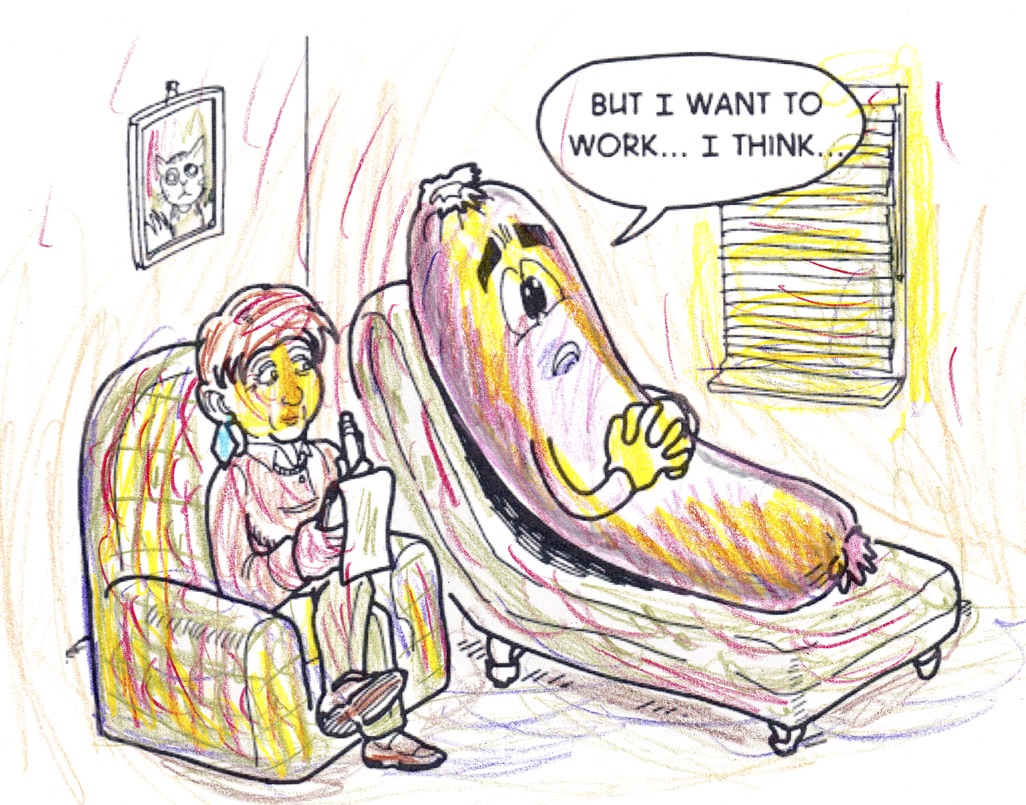
“We have endured year after year of austerity with cuts to our services and benefits and jobs, whilst the already far too rich are coining it in. Britain is the site of gross and unacceptable levels of inequality, and it keeps getting worse. Nothing that comes from the mouths of this government can be trusted, as they continually say one thing whilst doing the complete opposite. We are faced with crises in every sphere of the services that we need including education, social care, prisons, mental health services, housing, zero hours contracts and the health service. All are being undermined and destroyed whilst the corporate media mainly ignores the hell that has been created for so many, or distracts us with endless propaganda campaigns designed to get us turning in on one another whilst the corporations steal away everything that our grandparents struggled to achieve.”
Roy Bard MWA zine#2
Details of the protest here
Read the Mental Wealth Alliance zine for the protest here

Can FPN find a place in community networks?
Without real practical connections becoming alive and sparking between people in communities, then politics dies.This is George Monbiot’s thesis. Monbiot – activist, researcher and writer – has been laying out his vision of a reborn politics based on a thick web of interconnected grass roots and community activities.
Given the state of so many shattered communities, today’s politics can easily become all about argument and policy. It gets to seem dry, thinned out and irrelevant to most people. Live connected communities are essential if politics is to become vital and relevant to most people.
Over the last 20 years, the winds of globalisation have ripped through many communities and towns, atomising us, breaking down real connectivity between people. Recently it has become public knowledge just how many people are living such lonely isolated lives, that they may not speak to another person in a whole week. George Monbiot has written in the Guardian (8th Feb 2017 ):
“It is in the powder of shattered communities that anti-politics swirls, raising towering dust-devils of demagoguery and extremism. These tornadoes threaten to tear down whatever social structures still stand. When people are atomised and afraid, they feel driven to defend their own interests against other people’s. In other words, they are pushed away from intrinsic values such as empathy, connectedness and kindness, and towards extrinsic values such as power, fame and status.”
We need to restore community life in all its many varieties as a solution and response to the many crises we face. George Monbiot argues for creating thick networks – ” projects that develop a dense participatory culture ” – and he cites the example of Rotterdam in Holland where one estimate suggests there are now 1, 300 civic projects in the city. In the same article, Monbiot also looks at Todmorden in Yorkshire.
The question that I want to ask is this – is this movement that is participatory grass roots network the sort of movement that FPN should be linking up to, and contributing to? If Yes, then how do we start to do that?
Andy Metcalf
February 2017
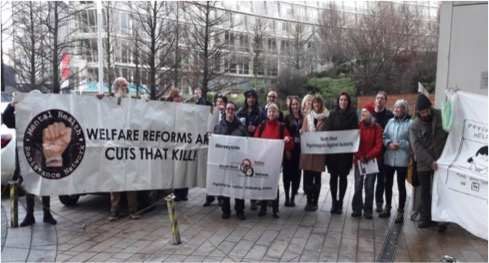
United against welfare cuts and welfare reform: report from the lobby of the British Psychological Society conference, 18th January 2017
The challenge to the government’s draconian welfare reforms are gathering momentum, and as part of this campaigners from across Merseyside and even as far afield as London gathered outside the annual BPS Clinical Psychology Conference at the Hilton Hotel, Liverpool on Wednesday 18th January. The British Psychological Society (BPS) is the professional body for UK psychologists and has been working with the government on aspects of its welfare reform programme.
Service users/survivors, mental health workers and clinicians from a range of groups including Psychologists Against Austerity (PAA), Mental Health Resistance Network, Disabled People Against Cuts, Social Work Action Network (SWAN) as well as trade unionists arrived bright and early at the venue to share our concerns with conference attendees. There is strong evidence of the detrimental impact of welfare reform on claimants with mental health needs so we are calling on the BPS to withdraw from all work with the Department of Work & Pensions (DWP) and join us in demanding the government end their harmful welfare reform programme.

Campaigners from a number of groups united to send a powerful message to the BPS leadership
As a result of our lobby, delegates informed us that welfare reform had become a major discussion point for attendees inside. Then as a result of this pressure a call came through to inform us that Peter Kinderman, president of the BPS, had invited us to address the conference the following day to explain our position and present our demands.
The next morning a group of campaigners representing the breadth of our alliance –service-users/survivors, a carer, and activists from North West Psychologists Against Austerity, Mental Health Resistance Network and SWAN – spoke to 300 psychologists at the first session of the conference. The group shared a strong message about the effects of welfare reform and called on the BPS to withdraw from all collaboration with the Department of Work & Pensions. In his response BPS president Peter Kinderman accepted some of our arguments but maintained that the BPS needs to continue to work with the DWP to get its perspectives heard. We reject this argument. We believe continued BPS involvement only lends credibility to the government, and BPS withdrawal would send a strong message about clinicians’ and service users’ concerns. We will continue to call for an end to all collaboration between the BPS and DWP.

Campaigners are invited onstage to address 300 psychologists at the BPS Conference
The DWP is an unethical body that is damaging the lives of claimants with mental health needs.
The statistics and evidence on the harmful impact of welfare reform are clear:
- 20,000 people with mental health difficulties had their benefits sanctioned in 2015
- Following Work Capability Reassessment, there is a greater risk of suicides, self-reported mental health problems, and antidepressant prescribing (Barr et al, 2015)
- 2,380 people died shortly after being declared able to work between 2011 and 2014
- Government & corporate collaborators are imposing psychological explanations for unemployment, together with mandatory activities intended to modify beliefs, attitude, disposition, or personality – this is being called psychocompulsion (Friedli & Stearn, 2015)
- The United Nations “is deeply concerned about the various changes in the entitlements to, & cuts in, social benefits introduced by the Welfare Reform Act 2012 & the Welfare Reform & Work Act 2016”. The UN has called on the Government to: “Review the entitlement conditions & reverse the cuts in social security benefits introduced by” these Acts
However we believe that this action and the growing campaigns around the country are starting to make a difference on this issue. A number of clinical psychologists attending the conference told us that the lobby and ensuing discussions would help to strengthen their voices within the BPS to make the case against the organisation’s involvement with the DWP.
We believe that when service users/survivors, psychologists and other mental health workers come together we are stronger. We will keep building alliances to pressure the BPS to withdraw from involvement with the DWP and to bring an end to the government’s wider programme of welfare cuts, reforms and psychocompulsion. If you would like to get involved please email us on mhwelfarereform2016@gmail.com.
 the free psychotherapy network