Category: Uncategorized
Join us and help bring new life to the Network
A message from the new steering group forming after the FPN meeting on 27th September
Dear all,
It was lovely to see those of us who were able to attend the Zoom meeting on Sept 27th about the future of FPN – some new faces, and some familiar.
There certainly seems to be an appetite for keeping the FPN directory going as a valuable resource for clients wanting to access ‘proper therapy’ but without the means to pay our usual rates, and for finding ways to expand this to better meet the needs of our communities. There was also some appetite for reviving FPN as a conduit for campaigning as it was when it first began more than 10 years ago, and for opening up the support we provide for one another, perhaps through local groups, or peer supervision.
Paul, Nicola, Andy and Andrea, who started us off in 2014, will remain involved and listed on the directory, but are ready to begin to hand over the reins as they turn their attentions toward other things – so we’re putting a call out for anyone who’d be interested in being part of a new Steering Group to take us forward. There’s no requirement for any major time commitment from anyone stepping forward: just a will to keep FPN going, and some capacity for a degree of practical involvement.
If you’d be open to exploring playing a part in this, just get in touch on the FPN email at freepsynetwork@gmail.com We’ll then get everyone together to consider what needs doing now, what we might like to do in the short and longer term futures, and how we’re going to make it all happen. Don’t be intimidated – we’re all plenty busy, I know. Let’s find a way to shape it so FPN serves us, and continues to be valuable as a resource for clients and a network for therapists.
Many thanks,
Marsha, Darya, Harriet
Albatross Collective: a network of radical clinicians offering psychotherapy and psychoanalysis to people on the left
Dear FPN,
We are writing to let you know that a radical psychotherapy group I’m part of has just launched its website and three new initiatives. We’d be grateful if you could share the below with Free Psychotherapy Network colleagues and through other networks.
The Albatross Collective is a London-based collective of psychotherapists, psychoanalysts and clinical psychologists. We are working to develop ways of doing psychotherapy and psychoanalysis that are accessible, liberatory and that support social action.
The collective coordinates the Albatross Clinic, a network of radical clinicians offering psychotherapy and psychoanalysis to people on the left. People looking for a therapist or analyst can write to albatrossclinic@protonmail.com to enquire about an initial consultation with a network member or find out more here.
The Albatross Collective also supports groups and community organisations by holding space for members to think and feel together about difficult experiences. Contact us at albatrosscollective@protonmail.com to discuss support for your group or find out more here.
Finally, in 2025/26 we are working with Cooperation Town to pilot a free social action psychotherapy project for council estate residents in Gospel Oak. More information about this will be available on our website soon.
You can also follow us on Instagram: @albatross_collective
Please share far and wide!
Albatross Collective
New radical psychotherapy initiative
Dear FPN members and friends,
I’m writing to let you know that a radical psychotherapy group I’m part of has just launched its website and three new initiatives. We’d be grateful if you could share the below with Free Psychotherapy Network colleagues and through other networks.
The Albatross Collective is a London-based collective of psychotherapists, psychoanalysts and clinical psychologists. We are working to develop ways of doing psychotherapy and psychoanalysis that are accessible, liberatory and that support social action.
The collective coordinates the Albatross Clinic, a network of radical clinicians offering psychotherapy and psychoanalysis to people on the left. People looking for a therapist or analyst can write to albatrossclinic@protonmail.com to enquire about an initial consultation with a network member or find out more here.
The Albatross Collective also supports groups and community organisations by holding space for members to think and feel together about difficult experiences. Contact us at albatrosscollective@protonmail.com to discuss support for your group or find out more here.
Finally, in 2025/26 we are working with Cooperation Town to pilot a free social action psychotherapy project for council estate residents in Gospel Oak. More information about this will be available on our website soon.
You can also follow us on Instagram: @albatross_collective
Please share far and wide!
Time for change at FPN
Dear FPN colleagues and friends,
I am writing to let you know that I am thinking about stepping back from the administration of FPN in the near future. We are now over 10 years old. After the early years of energy as a political venture combining the provision of free counselling and therapy for people on benefits/low incomes with activism around social inequality and the abuse of counselling and psychotherapy in the service of capitalist agendas, FPN as an organisation has become exclusively focussed on providing free and very low cost therapy. This is as important a project as ever.
We still have new therapists joining us as well as leaving the list. Overall the number of therapists has changed little – around 80. A lot of us now have notices under our entry saying we have no vacancies. Though the number of visits to the websites has fallen from a peak in 2021, we still have 50,000 visits and around 25,000 unique visitors a year.
For several years FPN has been run by a small group of therapists, based in London. Some of us are getting old (me for example) and/or are committed to a range of political campaigns including other projects around therapy and politics.
I think FPN needs a new lease of life with new people interested in organising it, revisioning its identity and mission. I am happy to help see a transition through. At the same time, I will be stepping back over the next year.
Nicola Saunders, Andy Metcalf and I met recently to discuss the issue and decided to call a general meeting on 27th September of FPN therapists, supporters, and anyone interested in the project to talk about where we go from here. Hopefully, ideas and energy committed to revitalising and keeping FPN alive will come out of that meeting. If not, we may have to think about how to responsibly close the project.
One of the issues is how few general meetings of members and friends we have managed to host in the past few years. As a consequence, we have lost touch with how much energy and passion people in the Network have for the project. We are writing to some of you whose active participation we are aware of to ask for your thoughts on FPN’s future and to help prepare for a general meeting in September. Could you please give this some thought over the next few weeks and come back to me with your responses. We will be sending out notice of the September meeting during July.
All good wishes for the Summer.
Paul Atkinson
paulwilliamatkinson@gmail.com
Statement from Partners for Counselling & Psychotherapy (PCP), 13th October 2022.
On Monday 10th October 2022, World Mental Health Day, the Government announced £122 million of funding for mental health. But the bitter reality is that this money is not being spent on in-patient beds, community mental health initiatives or trained counsellors and psychotherapists for public mental health services. Instead the Government is using this money to recruit and train 700 ‘employment advisers’ to work alongside therapists in the NHS’s flagship Improving Access to Psychological Therapies (IAPT) programme. This will help drive the highly contested policy of ‘welfare conditionality’ that threatens benefits claimants with sanctions if they don’t conform to certain patterns of behaviour, a policy which targets the poorest and most deserving sections of our society at a time when they need the greatest help.
Despite the timing of the press release, the money announced is not being used to build mental health support. Instead it is an expansion of an existing IAPT-based scheme providing, as the announcement states, ‘combined psychological treatment and employment support to help [people] to remain in, return to or find work and improve their mental health’ {1]. The linking of work and mental health, however, is deeply problematic. In 2015, hundreds of counsellors, psychotherapists and academics opposed the pilot scheme that first put together Jobcentre employment advisors and IAPT therapists, a scheme that in a letter to the Guardian [2] the signatories denounced as anti-therapeutic and professionally unethical.
Nothing has changed except that this policy now threatens to coerce a greater number of people into a system of employability interventions and psychological treatment in order to avoid sanctions on their welfare payments, including the main disability grants. As the highly contested Universal Credit programme is rolled out across the UK in response to rapidly growing low pay and job insecurity, many more people will be unable to secure living wages and will be forced into the benefits regime, where they will be subject to this pressure to undergo combined psychological interventions and employment advice.
What is the role of therapists in such a system? For us, work is not a health outcome. Employment is not an expected or even inherently desirable result of genuine counselling and psychotherapy. Real therapy does not aim to return individuals to the workplace or to keep them in jobs that may be economically insecure, psychologically toxic, systemically oppressive and personally damaging.
The linking of State therapy and employment advice, particularly if connected in any way with a punitive benefits system that has the power to sanction claimants for their perceived failures to find work, must surely contaminate some of the central tenets of good therapy – not least the autonomy and right to self- determination of the person undertaking it. The rolled-out scheme may be trailed as ‘voluntary’ but if ‘employment advisers and therapists will work together so that a person can return to or find work easier and faster’, as the Government say, then the non-coercive integrity of the therapy cannot realistically be maintained.
Given that the Government statement is at pains to point out how the overall aim of the project is ‘driving economic growth’, we also have to ask therapists whether they can – ethically and in good faith – align their practices with such an agenda. The therapist’s job is not to work from an assumption that ‘work is good’ or to aim to reduce the number of people receiving benefits, including disability benefits that are increasingly claimed on the basis of mental illness, but to provide an opportunity for reflection on all aspects of a person’s life.
As a network of organisations representing counsellors and psychotherapists, we at PCP believe that this announcement on World Mental Health Day is a cynical attempt to reduce government spending at the expense of people who most need genuine therapeutic support during an unprecedented period of economic crisis. We reject the financial logic that underpins the linking of employment and wellbeing services as it is a profound attack on the principles of talking therapies and will lead to a cruel and measurable deepening of the UK’s mental health crisis.
- https://www.gov.uk/government/news/122-million-employment-boost-for-people-receiving-mental-health-support
- https://www.theguardian.com/society/2015/apr/17/austerity-and-a-malign-benefits-regime-are-profoundly-damaging-mental-health
Partners for Counselling & Psychotherapy
http://www.partnersforcounsellingandpsychotherapy.co.uk
email: admin@partnersforcounsellingandpsychotherapy.co.uk
twitter: @pcp_uk #workcure #psychocompulsion
Free Psychotherapy Network: where do we go from here?
An online meeting for members and supporters of the Free Psychotherapy Network
Saturday 21st November 11am – 1pm

Dear FPN therapists and supporters,
Please join us to discuss the future of FPN. We have been going for over six years now, offering free therapy to people on benefits and low incomes. Our website has 35,000 visitors a year. We have 50 plus therapists, half in Greater London and the rest throughout England, Scotland, Wales and Northern Ireland. The demand from people wanting therapy is overwhelming, especially in the London area.
As well as linking clients and therapists through the website, FPN has been campaigning on issues around the politics of counselling and psychotherapy – workfare and psycho-compulsion, the lack of open-ended relational therapy on the NHS, and support for the social model of mental health. We have also been providing free group support online for people isolated during the Covid pandemic.
We recently joined Partners for Counselling and Psychotherapy – a new umbrella group of progressive therapy organisations.
The organisational side of FPN has been mainly done by a small group of us based in London. Recently we have mainly just looked after the website and answered queries. A few of us meet regularly for peer supervision of our free work.
Join us to think about FPN’s future, to explore new ideas for expanding the network and campaigning for social and psychological justice.
We definitely need more therapists. How can we campaign to encourage more therapists to join us?
Given the experience of working online under Covid, can we start pooling enquiries and connect people by availability online rather than just geography.
We could do more Covid support groups online. And more peer supervision of free work.
Some of us have been thinking about a campaign for “real therapy” – more provision of open-ended relational therapy through community-based therapy collectives as well as through the NHS.
The NHS recently published an ambitious long term plan for community-based mental health provision, something that won’t happen without challenge. One possibility for the future – some community centres are offering us rooms for doing free work.
Come and join us on Saturday 21st November, and help us think about where we go now. We are using an Eventbrite page for people to register so we have an idea of who’s attending. We will organise it on Zoom and email the link to anyone who wants to come.
Register now to receive the Zoom link – click here to register on Eventbrite
Circulate this Eventbrite link to anyone you think might be interested: https://www.eventbrite.co.uk/e/free-psychotherapy-network-where-do-we-go-from-here-tickets-124245739351
For more info and contact email, see here

Letter from #MillionsMissing Campaign – May 12th 2018 (ME Awareness Day)

Dear Free Psychotherapy Network,
I was very interested in the article on your website calling on therapists not to collude with harmful back-to-work therapies and pyscho-compulsion.
You may not know, but the model for these therapies have been forced upon a group of patients with a physical disease for decades. The rooted of the BPS model go back to the PACE trial on people with ME. This trial was part funded by the DWP and set out to prove that instead of the neurological condition described by the WHO it was a combination of deconditioning, fear of activity and false illness beliefs. The ‘success’ of this trial has long been disputed by patients but is only now coming under scientific scrutiny.
PACE has been used to ‘prove’ that CBT and graded exercise are an effective way to return people to health. Unfortunately, even trivial exercise such as having a shower has a catastrophic effect on ME sufferers, leaving them bed bound and in pain. Some never regain the level of functioning they had before treatment. However, they are told that it their fault for not trying hard enough or not challenging their false illness beliefs. Parents are accused of perpetuating their child’s illness and there are a high level of accusations of FII against mothers.
The PACE trial has been thoroughly debunked but it’s influence continues and has contributed to the appearance of scientific evidence for IAPT. https://bmcpsychology.biomedcentral.com/articles/10.1186/s40359-018-0218-3
ME sufferers have been the ‘canary in the coal mine’ for many years, protesting without being heard. The BPS lobby has been able to stigmatise a whole group of patients as ‘militant activists’ and akin to the animal rights lobby in the level of danger they present to scientists.
However, in the only legal arena that these accusations have been examined they were found to be ‘grossly excessive’.
This harm has been compounded by the blocking of any research that doesn’t fit the BPS view. Any protests are met with contempt and the accusation that people with ME are afraid of being seen to have mental health problems. It is a perfect Catch 22. If you don’t protest then you are assumed to agree that ME is a mental health issue. If you do protest then it proves that you have a mental health problem but are in denial. In reality, sufferers are only asking for effective treatment for their primary biomedical problem. They welcome counselling to help them accept the limitations that this long term illness has forced upon them. ME sufferers are in the same position that people with MS were before the discovery of a bio marker when it was considered to be hysterical paralysis.
Things are now changing around the world. In the USA the NIH has found insufficient evidence for CBT and GET http://www.meassociation.org.uk/2016/08/us-federal-agency-downgrades-its-advice-on-cbt-and-get-occupy-m-e-website-16-august-2016/ The Dutch have recently done the same https://www.meaction.net/2018/03/23/dutch-health-council-downgrades-get-for-me-cfs/
NICE are reviewing the UK guidelines but have refused to remove them until the end of the process, which will take at least 2 years. In that time many more patients will experience iatrogenic harm.
MEAction are holding a series of demonstrations across the UK on May 12 to draw attention to the #MillionsMissing from their own lives. We are asking therapists to stand with ME patients in asking NICE to stop GET now, rather than wait for the 2 year period to expire.
I am organising the London MillionsMissing protest and reaching out beyond the ME community to ask for allies. https://www.facebook.com/millionsmissinglondon2018/
Sincerely,
Denise Spreag

Mental health industry collaborates with damaging state welfare reforms
Watch Denis Postle’s video of the New Savoy demo 21 March 2018
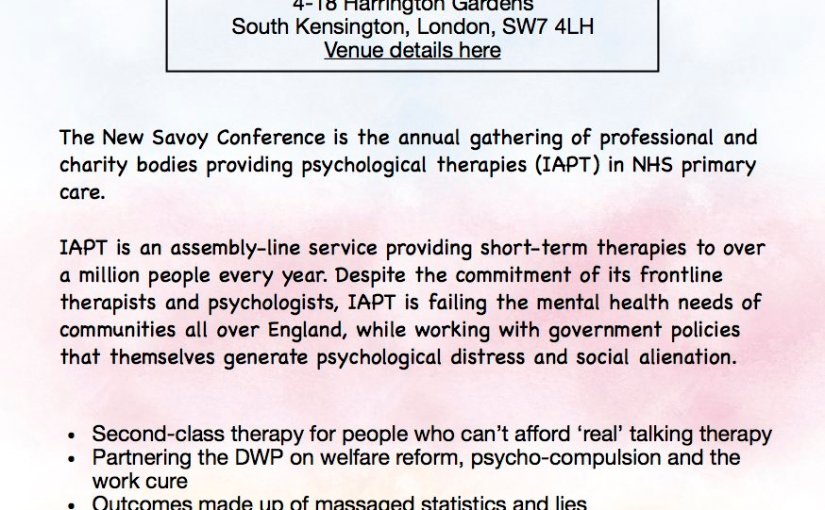
Demo at New Savoy Conference 21st March 2018
The Alliance for Counselling and Psychotherapy has organised a demo at the New Savoy conference again this year. Please circulate the flyer linked here to your networks and come along yourself if you can make it. It’s an early start at South Kensington.
Here’s the programme for the conference – http://www.healthcareconferencesuk.co.uk/conf/uploads/brochures/1210_20180214-104528_Psychological_Therapies_2018_Brochure.pdf
Some context:
• The hierarchy of IAPT and psychological services in the NHS who gather at these conferences continue to offer liberal mouthings about DWP welfare reform policies, WCA and PIP, sanctions, coercion around Work and Health. But they’ve actually taken no real action to boycott DWP/Health collaboration, despite all the developments re judicial reviews, UN condemnations, the recent Parl Committee report, and the UC debacle.In his intro to the conference, in the programme link above, Jeremy Clarke (NS chair) says:
“The second issue is the running sore of welfare benefit reform, and its negative impact on mental health, that undermines whatever benefit we make to population wellbeing. Have we reached a consensus now for how we can turn the tide? The BBC’s Mark Easton will find out”
• The overall theme is depression; there are sessions on the crisis in the IAPT workforce, latest staff survey, impact of targets; session on Work and Health Unit; Wessely’s review of human rights and compulsory treatment; session on Employee Assistant Programmes (often run by people like Maximus); familiar faces in the list of speakers.
• The scam of IAPT as a service in local communities. IAPT has a massive evidence base, tons of statistics for every CCG in England including “recovery” rates; ethnicity stats; deprivation stats; etc etc No-one really analyses the figures. For IAPT, it seems just collecting the stats is their claim to being evidence based and therefore their claim for funding from the Government. In fact, their stats reveal a shockingly failing provision.
For example, out of over 1,350,000 referrals a year, 85% either never enter any kind of therapy, or never finish a course of treatment, or don’t “move to recovery” (as IAPT jargon has it). In my CCG (Tower Hamlets) only 6.6% of referrals to IAPT “recovered” and among the Bangladeshi community who make up over 30% on TH population only 3% “recovered”. Paul Farmer’s Taskforce target for % of population who “need IAPT therapy” is 15%, rising to 25% by 2021. In TH about 2% of the pop were referred/referred themselves to IAPT, of whom as I say 6.6% “recovered”.
IAPT will be a major part of the propaganda around the NHS reorganisation now in progress, via the STPs and the ACOs they are developing (link here for more info on this). STP management have “the mental health crisis” high on their agenda – certainly their PR agenda – and selling more provision for IAPT services will be a major plank of the campaign. See Hunt on this role for IAPT here.
IAPT is rarely taken to task as a service that is massively failing communities all over England. This is true in the Labour Party as much as anywhere else. This has to stop. It is a propaganda service for neoliberal capitalism and its dissemination of psychological scapegoating and coercion across society.
Hope to see some of you on the 21st,
Paul Atkinson


New Savoy Protest against psycho-compulsion of MH claimants – 15th March 2017
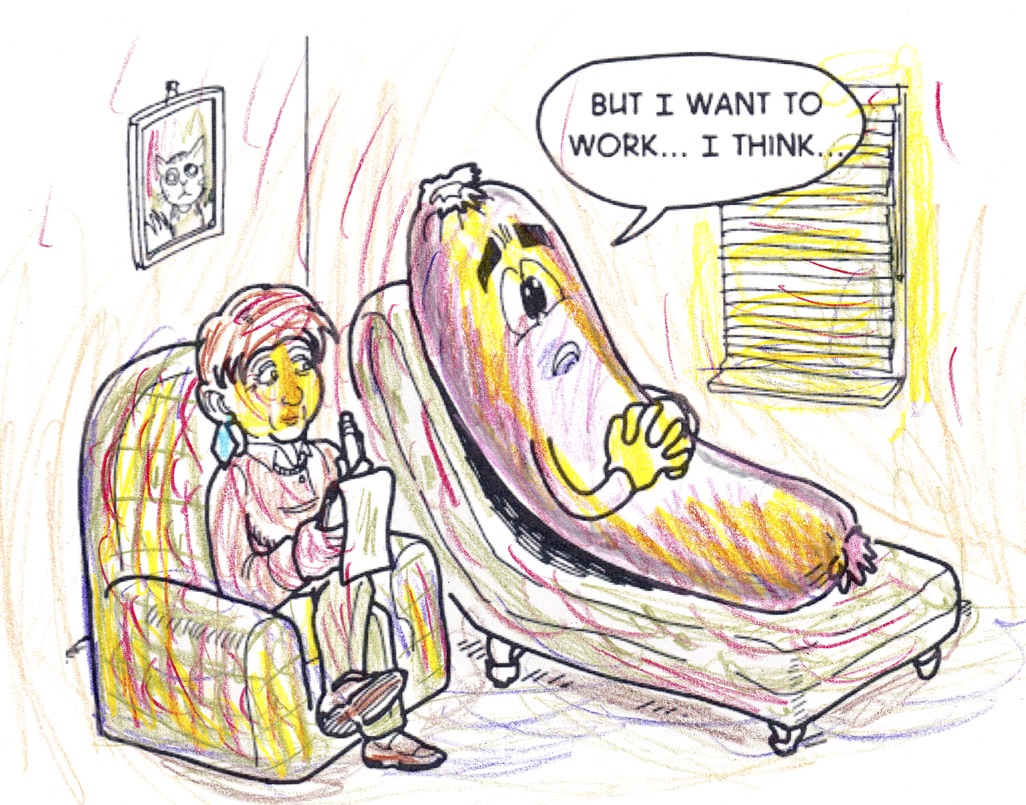
“We have endured year after year of austerity with cuts to our services and benefits and jobs, whilst the already far too rich are coining it in. Britain is the site of gross and unacceptable levels of inequality, and it keeps getting worse. Nothing that comes from the mouths of this government can be trusted, as they continually say one thing whilst doing the complete opposite. We are faced with crises in every sphere of the services that we need including education, social care, prisons, mental health services, housing, zero hours contracts and the health service. All are being undermined and destroyed whilst the corporate media mainly ignores the hell that has been created for so many, or distracts us with endless propaganda campaigns designed to get us turning in on one another whilst the corporations steal away everything that our grandparents struggled to achieve.”
Roy Bard MWA zine#2
Details of the protest here
Read the Mental Wealth Alliance zine for the protest here

Mental Wealth Alliance response to the psy professional bodies’ statement on benefit sanctions and mental health 30/11/16
From:
Mental Wealth Alliance[1]
Mental Health Resistance Network; Disabled People Against Cuts; Recovery in the Bin; Boycott Workfare; The Survivors Trust; Alliance for Counselling and Psychotherapy; College of Psychoanalysts; Psychotherapists and Counsellors for Social Responsibility; Psychologists Against Austerity; Free Psychotherapy Network; Psychotherapists and Counsellors Union; Social Work Action Network (Mental Health Charter); National Unemployed Workers Combine; Merseyside County Association of Trades Union Councils; Scottish Unemployed Workers’ Network; Critical Mental Health Nurses’ Network; National Health Action Party.
To:
British Association for Behavioural and Cognitive Psychotherapies
British Association for Counselling and Psychotherapy
British Psychoanalytic Council
British Psychological Society
United Kingdom Council for Psychotherapy
30th January 2017
MWA response to the psy professional bodies’ statement on benefit sanctions and mental health 30th November 2016
We welcome the call from the psychological therapy bodies for the government to suspend the use of sanctions by the DWP subject to the outcomes of an independent review of its welfare policies and their potential damage to the mental health of benefit claimants. Given the accumulation of evidence over many years of the material and psychological suffering inflicted on benefit claimants by workfare-based conditionality[2], it has been frankly shocking that the professional bodies directly concerned with the mental health of the nation have preferred to welcome and participate in workfare policies rather than publicly and vociferously dissociate themselves.
The timing of the statement is given to be the recent report on sanctions by the National Audit Office. Welcome as its report is, the NAO’s perspective on government policy is primarily monetary, not one of health, ethics and social justice. Its “vision is to help the nation spend wisely”. The choice of this timing represents realpolitik on the part of the professional bodies no doubt, as perhaps is the intention of the conditional statement: “The sanctions process may be detrimental to people’s mental health and wellbeing”. But surely as psychotherapists and counsellors we can do better to represent the overwhelming evidence of personal suffering on such a scale than point to poor returns on expenditure and an ambivalent proposal that sanctions may be detrimental to people’s mental health.
Sanctions are only one dimension, albeit at the sharp end, of a welfare regime based on the political assertion that people need to be coerced off benefits and “nudged” into work. The psychological pressure of WCA and PIP assessments, job search rules, work programmes on “good employee” behaviours and the regular cuts to welfare benefits generally are part and parcel of the psycho-compulsion of the DWP benefits regime.[3]
We dispute the government’s premise that work is a therapeutic priority for people suffering from mental health difficulties. The marshalling of evidence for this modern-day workhouse mentality lacks both substance and integrity. Work has become the ideological mantra for neoliberal welfare policies.
Obviously where people want to work and where employment possibilities exist that will support and nourish people’s mental health, then encouragement, training and professional support should be available. But why is there no acknowledgement of the hundreds of thousands of claimants with mental health difficulties who cannot work, whether they want to or not?[4] Where is the evidence that people with mental health difficulties are actually benefiting from what is now two decades of workfare conditionality in the UK? Where is the evidence that in our current labour market decent jobs exist that will nourish people’s mental health? And where is the evidence that psychological therapy for benefit claimants with long-term mental health disabilities succeeds in supporting them into decent jobs they want, can survive and maintain?
When the professional bodies say, “an estimated 86-90% of people with mental health conditions that are not in employment want to work”, they are supporting the proposition that getting into work is an overwhelmingly important and efficacious goal for this group of benefit claimants. It is not clear where this figure comes from and what it means.
A similar figure is quoted by The Royal College of Psychiatrists’ report on Mental Health and Work (2013)[5], making use of a Sheffield study by J. Secker and others (2001)[6]. In fact, Secker finds that of their sample of 149 unemployed service users, when asked if they were interested in work of any kind – including voluntary and supported work – “around half (47%) responded positively, and almost the same proportion (43%) had a tentative interest. Only 15 people (10%) had no interest in work”. At the same time, only 25% of respondents saw full-time employment as a long-term goal. 71% said that their preferred vocational assistance would be “help for mental health/keep current service”.[7]
This study does not translate into “86-90% of people with mental health conditions that are not in employment want to work”.[8] What it points to is the complex texture of attitudes, desires and fears around waged work that are the common experience of service users, alongside the harsh realities of the current labour market, the socio-economic environment generally, and the dire state of mental health services of all kinds more particularly.[9]
From our point of view, the professional bodies’ statement is a step in the right direction. It is a step that must now be followed through with active political pressure on the DWP and the Dept of Health to suspend sanctions and set up an independent review of their use, including the damage they inflict on people’s mental health. Parliament has already called for such a review.[10]
But more than this, the remit of such a review should include all aspects of conditionality in a benefits system that deploy psycho-compulsion through mandatory rules or through the more subtle imposition of behavioural norms which aim to override the claimant’s voice.
We again suggest that the psy professional bodies would benefit by widening their own conversations to include service users and the rank and file of their membership. They would also win more credibility as organisations with ethical and social values independent of the government’s policies of dismantlement of social security and the welfare state if they were willing to make transparent their currently private conversations with DWP.
[1] Mental Wealth Alliance (MWA), formerly the Mental Wealth Foundation, is a broad, inclusive coalition of professional, grassroots, academic and survivor campaigns and movements. We bear collective witness and support collective action in response to the destructive impact of the new paradigm in health, social care, welfare and employment. We oppose the individualisation and medicalisation of the social, political and material causes of hardship and distress, which are increasing as a result of austerity cuts to services and welfare and the unjust shift of responsibility onto people on low incomes and welfare benefits. Our recent conference focused on Welfare Reforms and Mental Health, Resisting the Impact of Sanctions, Assessments and Psychological Coercion.
[2] Parliamentary committees, the national press, endless reports from charities, service user organisations, people with disabilities, claimants unions and workfare campaigners have been reporting the physical and psychological damage of ‘welfare reform’ and its tragic outcomes for a decade.
[3] On psycho-compulsion and the benefits system see Friedli and Stearn http://mh.bmj.com/content/41/1/40.full and https://vimeo.com/157125824
[4] In February 2015 over a million people claiming ESA under a MH diagnosis were in either the Support Group or WRAG. Over 70% of new applicants for ESA are found unfit for work
https://www.gov.uk/government/uploads/system/uploads/attachment_data/file/470545/3307-2015.pdf
[5] https://www.gov.uk/government/uploads/system/uploads/attachment_data/file/212266/hwwb-mental-health-and-work.pdf p.17
[6] Secker, J., Grove, B. & Seebohm, P. (2001) Challenging barriers to employment, training and education for mental health service users. The service users’ perspective. London: Institute for Applied Health & Social Policy, King’s College London.
[7] Ibid, pp. 397-399
[8] Compare a DWP survey of disabled working age benefit claimants in 2013. 56% of 1,349 respondents agreed that they wanted to work. Only 15% agreed that they were currently able to work. Only 23% agreed that having a job would be beneficial for their health. https://www.gov.uk/government/uploads/system/uploads/attachment_data/file/224543/ihr_16_v2.pdf
[9] For example, some of this complexity is flagged by Blank, Harries and Reynolds (2012) The meaning and experience of work in the context of severe and enduring mental health problems: An interpretative phenomenological analysis Work: 47 45(3) “Stigma, the disclosure of a mental health problem and the symptoms of the mental health problem are frequently described, as well as feelings of hopelessness, seeing recovery as uncertain, and feeling a lack of encouragement from services. Difficulties in accessing occupational health services, having a disjointed work history, lack of work experience, age, lack of motivation and fears about competency, as well as the social benefits system and caring commitments, are also experienced as barriers to accessing employment for people with mental health problems.”
[10] https://www.parliament.uk/business/committees/committees-a-z/commons-select/work-and-pensions-committee/news/benefit-sanctions-report

Open letter to therapy’s professional bodies on the psychocompulsion of welfare claimants – from the Mental Wealth Foundation
_______________________________________________________________
Mental Wealth Foundation is a broad, inclusive coalition of professional, grassroots, academic and survivor campaigns and movements. We bear collective witness and support collective action in response to the destructive impact of the new paradigm in health, social care, welfare and employment. We oppose the individualisation and medicalisation of the social, political and material causes of hardship and distress, which are increasing as a result of austerity cuts to services and welfare and the unjust shift of responsibility onto people on low incomes and welfare benefits. Our recent conference focused on Welfare Reforms and Mental Health, Resisting the Impact of Sanctions, Assessments and Psychological Coercion.
________________________________________________________________
Date 21 March 2016
From:
Mental Wealth Foundation
Mental Health Resistance Network
Disabled People Against Cuts
Recovery in the Bin
Boycott Workfare
The Survivors Trust
Alliance for Counselling and Psychotherapy
College of Psychoanalysts
Psychotherapists and Counsellors for Social Responsibility
Psychologists Against Austerity
Critical Mental Health Nurses’ Network
Free Psychotherapy Network
Psychotherapists and Counsellors Union
Social Work Action Network (Mental Health Charter)
National Unemployed Workers Combine
Merseyside County Association of Trades Union Councils
Scottish Unemployed Workers’ Network
To:
British Association for Behavioural and Cognitive Psychotherapies
British Association for Counselling and Psychotherapy
British Psychoanalytic Council
British Psychological Society
United Kingdom Council for Psychotherapy
Professional bodies scrutinise Government ‘therapists in job centres’ plans
We write in response to your joint public statement of 7 March 2016 outlining the outcome of your meetings with the Government’s new Joint Health and Work Unit and your scrutiny of the Government’s plans to place therapists in job centres [1].
There is no indication that any consultation has taken place with members of your organisations with knowledge of these matters nor with service users, clients and their representative organisations. This lack of consultation and opportunity for wider reflection has contributed to your organisations departing from your own ethical structures and frameworks, and being seen as agents of harmful government policy [2]. It is by now generally accepted that the consequences of the DWP and government policy in this area are far reaching for physically and mentally disabled people on social security benefits. Inexplicably your organisations’ scrutiny of government plans has failed to recognise this.
The joining of Government Health and Work Departments is not helpful, and current DWP policy intended to reduce the socio-economic causes of mental illness to the one simple fact of unemployment is clinically and intellectually ridiculous. The resulting policy promoting work as cure, which your organisations are now supporting, is offensive and dangerous. It is wrong for therapy organisations to buy into the unthinking praise for ‘work’ that often forms part of the rhetoric of governments.
While for some clients improving employment prospects may be an objective, for many others this is not the case and may be profoundly damaging. Indeed, for some people, their mental health problems may have begun because of work e.g. through experiences of bullying in the workplace. This one size fits all approach is simplistic. Premature return to work can result in loss of confidence and relapses affecting future ability to get back to work. This can also lead to prolonged periods without benefits and no income [3].
You state that plans must be aimed at improving mental health and wellbeing rather than as a means of getting people back to work. These are not the aims and objectives being expressed by the people who are implementing the programme right now, involving targeting ‘hard to help’ clients who are likely to be people with enduring physical or mental health difficulties. For example in the Islington pilot project Councillor Richard Watts has stated, “We think there is much more that health services can do to promote the idea of employment for people with health conditions.” In the Islington CCG Commissioners’ report in November calling for employment services in GP surgeries to reach ‘hard to help’ claimants, they state that, “to improve the system we need to…maximise the contribution of all local services to boost employment, making it a priority for health, housing, social care and training. We need to open up how we talk to people about employment, including asking healthcare professionals to have conversations about work with patients, as part of their recovery. We need to give professionals the information and tools to help them to do this.” [4]. For all clients, establishing a trusting relationship is the first priority, involving respecting their current needs, perspectives and autonomy.
Jobs advertised on the BACP website in November 2015 have the explicit aim of getting clients back to work and engaging with employment services e.g. “your role will include: producing tailored health action plans for each client, focusing on improving their health and moving them closer to work…generate health and wellbeing referrals to ensure continued engagement with employment advisers” [5]. Similarly G4S advertise jobs for BABCP accredited CBT practitioners with job roles including: “Targeted on the level, number and effectiveness of interventions in re-engaging Customers and Customer progression into work” [6].
We respectfully submit that information about these jobs was known to all of your organisations when you issued your joint statement. This inconsistency is seriously misleading.
We are glad that you oppose conditionality, coercion and sanctions. Clearly such punitive measures have no place in the therapeutic relationship. We fail to share your reassurance from the government that these measures will not be pursued against clients. DWP have repeatedly claimed that sanctions are a last resort and only happen in a tiny minority of cases. The reality is that millions of people have been sanctioned. In the twelve months to September 2015 alone, over 350,000 ESA and JSA claimants were sanctioned [7]. In the Employment Support Allowance Work Related Activity Group the majority of sanctions were of people who have been placed in the group specifically because they are experiencing mental health issues and research shows that benefit sanctions on people with mental health problems has increased by 600% [8].
It is not possible to consider this issue without considering the context of sanctions, cuts and persecution which is endemic in the current system. You fail to acknowledge that attending this proposed therapy may not be explicitly linked to conditions/sanctions but will feel so for many of its prospective clients who are on benefits. There is a structural power imbalance between job centre employees and those on benefits. With their income under threat, those on benefits will be especially susceptible to cues, suggestibility and positive reinforcement when attending job centres. Many on benefits have experienced oppressive power relations for much of their lives. Saying no in relation to an apparent free choice in this context is hugely difficult, especially when saying no has uncertain consequences [9] .
Attempts to coerce people into work are detrimental not only to their health but to their safety and, in many cases, present a risk to life. The extreme fear and distress caused by the current welfare reforms, including changes in disability benefits and the new Work Capability Assessments, is widely reported including instances that have led to suicide [10]. Therapy alongside this coercive system breaches the ethical principle of non-maleficence.
You state that there must be choice as to location of therapy. There is a clear danger in putting DWP representatives into GP surgeries, community centres and food banks that are seen as safe havens for people on low incomes and benefits. The presence of DWP compromises this. DWP/Maximus workers in the GP surgery, with access to medical records, will serve as a deterrent to people visiting their family doctor. The model currently in use in Islington allows Remploy/Maximus workers to access and write into GP records; this jeopardises any commitment to client privacy and confidentiality [11].
The choice of method of therapy is an illusion and therapists of all modalities are subject to the stresses of an unjust target driven culture [12]. We are concerned that under-qualified and inexperienced staff, such as job centre coaches, will be in a position to make referrals to Health and Work programs. This is exacerbated by the fact that referrals are likely to be to IAPT workers, many of whom themselves lack in-depth training and experience of severe mental health issues. Inappropriate referrals are increasingly likely in a target-driven culture.
We are not reassured that the feasibility trials planned by the government will contribute to knowledge and understanding and are not reassured by your echoing what government is saying. Instead you and government must listen to the voices of survivors who describe the reality of government plans on their lives and are fighting for services with a vision of humanity beyond work [13].
It is clear from your public statement that you have failed to critically examine and scrutinise the ongoing activities of the Government Joint Work and Health Unit. We call on you to cease your engagement with this unit and instead hold a national stakeholder event which is guaranteed to involve the participation of representative organisations for service users and therapists with direct knowledge of the area, as well as professional bodies like yours. There should be no government involvement in such an event. From it, a representative group can be selected that will adequately represent the views of service users and therapists to the appropriate government departments as well as to the opposition.
References
5 ‘Mental Health Advisor – Job Details’ Retrieved from http://www.bacp.co.uk/jobs/jobs.php November 21st, 2015. Available athttps://www.dropbox.com/s/a6p9mod1jb08dne/Mental%20Health%20Advisor%20-%20Job%20Details.docx?dl=0
6 http://careers.g4s.com/jobs/Cognitive-Behavioural-Therapist_58526/6 crisis
- For a fuller discussion of these issues, see http://mh.bmj.com/content/41/1/40.full

Empathy Explores Beyond Limits – Peter Ryan
Death is like a cold, dark whirlpool, a wave of suffering, just waiting to wash us away
you who rest in comfort upon the shoreline, how can you know our state? (Hafiz)
I am a passionate about spreading the word, work and wonder of empathy. This passion is born out of years counselling studies and practice experiences. However, it is individuals from various social, economic and cultural backgrounds that have shown me just how far reaching the cosmic dimensions of empathy can be. Empathy penetrates the darkest corners of the human condition and sheds an understanding light of acceptance onto the chaos of existence.
It has a Ninja-like quality of daring at its heart. I named this quality a courageous sensitivity.
The effectiveness of my courageous sensitivity to engage traumatised individuals in the therapeutic process is evidenced in Extending the Empathy Zone Embrace[1].
I believe, the secret to exploring hurtful experiences locked within the inner terrain of human existence is down to one fundamental fact – empathy is a born survivor. It thrives in the unknown, vulnerable, emerging presence, keeping its edge sharp. Instinct is empathy’s whiskers, intuition its resonator. Empathy recognizes, welcomes and treasures the individuality, personhood, identity, spirit or soul of the other human being in all its shared and unique aspects[2]. That is why, when labouring with raw materials from a client’s subterranean world, it is essential external forces of influence, bias and control on a person are equally welcomed for empathic exploration. Not all psychological problems are caused by childhood experiences; not all emotional stress concerns individuals. The influence of history, geography, economics, philosophy and religion on individual responsibility is vastly underestimated[3]. A closed system of relating only condemns people once again to draw in the exhaled breath of oppression found in stuffy, compartmentalised environments. An empathic ecosystem liberates individuals by its refreshing, interconnecting atmosphere. Its breath-taking relationship is designed to blend in with its surroundings, not to be apart from it.
Empathic understanding…always leads directly into the psychic connection itself. Rational understanding is merely an aid to psychology, empathic understanding brings us to psychology itself. (Karl Jaspers)
There is still a lot of misconception about empathy. It’s often mistaken as a fluffy, “female” feeling to be used as a tissue for mopping up tears. Nothing could be more wrong. Empathy is always knowledge-based[4] drawing on both masculine and feminine qualities beating quite capably at its organic heart. Empathy’s unisexual soul is the bedrock of what it means to be a complex human being. And attempts by many high ranking professionals seeking to place a “cognition crown” on empathy’s majestic head are doomed to failure. This top-down approach heavily laden with logic and order will just not do. Parading empathy in ordered logic as the ideal state of mind not only betrays a deep wariness towards human unordered and often irrational feelings and emotions but also demonstrates a poor understanding of empathy’s true power. Viewing empathy through such a lens condemns it to exist in a restricted, incongruent and lifeless enclosure whose walls are fiercely guarded by seemingly superior reason. If this state of affairs continues to gain ground in the counselling realm, it will rip the heart out of empathic engagements. I am reminded of the late Indian history writer and teacher, Abraham Eraly, who said: Everything was efficient and well-ordered in the Indus cities, most remarkably so, but there was little scope for artistic flourishes or individual creativity in this bloodless, precision-engineered society.
From the first moments of a therapeutic encounter with a client, I let empathy guide our way through the session. Empathy is felt and reasoned simultaneously. It is a quantum experience[5]. As the dynamics of our empathic connection develops and clients stop hugging the shoreline of familiarity then the spirit of adventure into understanding the waves of their suffering can begin. Empathy is the sail that keeps the vessel of healing afloat in the dark whirlpool. Therapy without empathy is not counselling. And counselling without empathy is not therapy. Empathy is not a ‘technique’ of responding to the client, but a way-of-being-in-relation to the client[6].
Empathy is extremely effective in alleviating shame – the underlying emotion of many disturbing feelings and behaviours. As beautifully expressed by five year shame researcher Dr Brené Brown: Shame is highly, highly correlated with addiction, depression, violence, aggression, bullying, suicide, eating disorders (…). Shame is an epidemic in our culture. Empathy is the antidote to shame[7].
In order to be vigilant against the creeping vine of shame and its ability to produce chock-off points, therapeutic engagement requires constant use of body awareness which is the gateway to keeping empathy fresh when dissolving shame. Empathy is not only a born survivor. It is the rescue service available in bringing isolated clients back from the brink of oblivion and into the fold of humanity. It is not for nothing that empathy represents the deepest expression of awe, and understandably is regarded as the most spiritual of human qualities[8].
I believe that finding answers to difficult issues is made easier when clients are fully supported by an empathic therapist who trusts in their capacity to transform. For empathy, in all senses of the word, involves an ongoing, ever-changing process of self-transformation[9]. This confidence in empathy and positive transformation has an evolutionary component embedded in my sense of trust. For we humans are gifted with possessing the most highly sophisticated powerhouse of abilities on the planet – the nervous system with the most powerful brain known to us. This highly specialised system utilises and arranges interactions between humans and the world around us. It is regulated by the constant flow of information via sensing, instinct, intuition, visceral experiences, images and perception. Being open and non-judgemental to the plethora of ‘subterranean gifts’, generated by new experiences, is vital to keeping our powerhouse in pristine top-notch shape. Consequently, if the nervous system is used to distort or deny perceptions and experiences, and emotions and feelings that those persecutions and experiences could/would evoke, it becomes overstressed and starts failing, and with it the zest for real, authentic life.
For empathy to thrive it must feel the pulse of emotion. Emotion is the engine where the zest for life is created. Emotion is the true touch-stone in successful empathic communication and is the gateway to authentic living. Authenticity is to empathy what water is to life. The bridge linking empathy and authenticity is called unconditional acceptance. Empathy distilled from a non-judgemental openness draws forth the clear, clean waters of authenticity in an endless cycle of rebirth and sparkling purity. Accessing the life force of authenticity is dependent upon maintaining the quality of a non-judgemental presence. Empathy and unconditional acceptance enhance one another in promoting movement towards congruent living.
Thus the first step towards an empathic life and authentic living is to take a stand. That is, take ownership of what we are experiencing and by doing so calibrate our ability to evolve fully into the unfolding moment. In counselling, as in life, limits imposed on experiencing the integral stream of our internal information system keeps human potential locked in a flat-earth landscape.
We don’t always have to express verbally what we are feeling, but, as Carl Rogers phrased it, we must be open to making our feelings available to our awareness. We need to tune in and trust in our private unique frequencies and rhythms. By doing so we allow for a more confident space to bloom in which the fruits for an empathic life and authentic living can be enjoyed.
To be faithful to that which exists nowhere but in yourself — and thus make yourself indispensable.
(Andre Gide)
[1] http://uktherapyguide.com/blog/extending-the-empathy-zone-embrace/
[2] http://www.empathictherapy.org/What-Is-Empathic-Therapy-.html
[3] Clarkson P. The therapeutic relationship. London: Whurr publisher Ltd; 2009
[4] Joseph S. and Worsley R. Person-centred psychopathology. United Kingdom: PCCS Books Ltd; 2012
[5] Rifkin J. The empathic civilization. Cambridge: Polity Press;2010
[6] Mearns D. and Thorne B. Person-Centred counselling in action. London: SAGE Publications, London; 2008
[7] https://www.ted.com/talks/brene_brown_listening_to_shame?language=en
[8] Rifkin J. The empathic civilization. Cambridge: Polity Press;2010
[9] Cinramicol A & Ketcham K. The power of empathy. London: Piatkus publications;2000
Going clean, going legal and the personal responsibilities of the ‘productive’ citizen – Lena Theodoropoulou

In theory
The coalition’s government [i] drug strategy for 2010-2015 is a clear, straight-forward document that describes their intentions and plans as well as the changes that actually took place in the UK drug recovery system during the past five years.
The document starts with a statement by the Home Secretary and her commitment to chase those involved in the drug trade; following that, she attempts to make an arbitrary link between drug use, organised crime and the security of UK borders. The inexistent in the real world, as described by the Home Secretary, distinction between drug users and drug traders is no news; the fact that it is mentioned though at the very beginning of the document makes it clear that for its instigators, addressing the connection between offending and drug activity (use or trade) is a priority for the ‘safety of the community’ and their strategy will evolve based on that conviction.
In the main body of the document it is mentioned that amongst the main targets of recovery is for individuals to cease offending, stop harming themselves and their communities and successfully contribute to society. Further on, it is stated that ‘key to successful delivery in a recovery orientated system is that all services are commissioned with best practice outcomes in mind’ that include: a reduction in crime and re-offending, sustained employment, the ability to access and sustain suitable accommodation, improved relationships with family members, partners and friends and the capacity to be an effective and caring parent. At the same time, the government calls the services to provide individualised, person-centred treatment and care plans tailored to the service-users’ needs. This is quite a paradox as, based on the guidelines above, it is obvious that the centre of attention is not the person that actually asks for help but the safety and wellbeing of the people and institutions around them. It is clearly stated that the services won’t be judged (and funded) on the premises of their therapeutic work, but on their ability to produce ‘good citizens’, meaning citizens that have a job, a house, are part of or in the process of forming a nuclear family, are good parents, do not offend etc. It is safe thus to conclude that individualised treatment only refers to the identification and correction of the ‘deviances’ in the service-users’ lives, rather than an effort to accompany them in the discovery of their own aspirations, plans and chosen way of being.
In Practice
As a support assistant at a residential detox and rehabilitation centre, I was invited to attend with the residents a group called GOALS, delivered by an external facilitator. The initials stand for ”Gaining Opportunities and Living Skills” and it is designed to teach the participants the ”Ten Keys of Success”. The facilitator introduces it as a course on how to become successful, delivered in a variety of settings, including companies that are interested in strengthening their employees’ motivation.
The GOALS group focuses on encouraging the participants to take responsibility for their own actions, acknowledge the fact that there is always a choice and learn how to leave the past behind them. The booklet of the course includes a variety of decontextualised catchy quotes coming from thinkers, philosophers and celebrities. Positive thinking and anger management become priority areas and the facilitator starts using examples on personal responsibility and the availability of choices. Among others, she uses the example of the UK’s age of criminal responsibility (the age of 10) and states that by that age people are able to tell the difference between right and wrong (and hence take responsibility and pay the consequences of their actions). The following example is about a man claiming that he had no other choice but to steal in order to feed his children. Once more, alternative options are presented to the group including food banks, or even looking for food in the garbage in order to avoid offending. And finally, when it comes to anger, the participants are advised to leave the past behind for their own good and learn how to forget and forgive.
Bit by bit and with one example after another, a value system is created, based on personal responsibility and the identification of legality with justice. It is also interesting that, although the examples used throughout the course didn’t mention directly drug/alcohol dependence, the connotation is obvious: obedience and legality equals a clean and happy life while disobedience and resistance equals social exclusion and relapse; and it is the enforcement of such equations that render the specific recovery model not just invalid but also unethical and dangerous. If there is a shared, universal feeling amongst people that have experienced drug addiction that would be guilt and shame. In addition to that, the route towards treatment is not an easy one. It usually involves lots of pain, disappointments and disillusionment as well as a feeling of defeat. All these conditions put the person that asks for help in a vulnerable, but also a very respectable position; manipulation though is definitely not the way to show respect. The government’s drug strategy pushes towards treatment that steps on peoples’ guilt and anger (in many cases the outcome of personal as well as social suffering) in order to create obedient, functional and productive citizens. Although the basic principles are quite similar in most treatment models, the reasoning behind them is completely different. Violence and offending for example constitute a ‘boundary’ in most treatment models around the world, not because it is ‘not right’ but because it reflects a lifestyle in many cases adopted during the times of addiction and bears negative connotations for the people in recovery. Additionally, linking offending, criminality and eventually drug dependence with resistance to social injustice and any behaviour that goes against the norms is again an effort to manipulate people during a very sensitive period of their life and takes us back to the initial point of this text that the government’s drug strategy is not about supporting the people that ask for help but about creating ‘safe communities’ and forcing social stability. Finally, playing the card of personal responsibility is an attempt to take the weight off the State’s back when it comes to social injustice and exclusion.
The subordination to a substance is the outcome of the original fear of a person to stand against the world with a clear mind; and this fear is not a choice but a result of the marginalisation since an early age of those that fail to fit in the prevailing social narratives and adapt to the rules of institutions. The failure there is not personal but systemic and has its roots in the imposition of social norms in a top-down fashion. The government’s approach to addiction creates a vicious circle that reproduces rules, restrictions and oppressions, even in the intimate and in theory free of all fear space of recovery.
All this is not to say that personal responsibility does not exist and does not play an important role in recovery. It does though alongside social and collective responsibility and does not only apply to the ex/drug users but to everyone else surrounding them, including drug workers, researchers, services, policy makers etc. Drug recovery is not (just) about being able to stay healthy, get a job and have babies. It is also an act of resistance, an escape from a pointless routine and a desire for freedom. Thus, addiction can only be treated in an environment that offers people the freedom to make their own choices, free of social expectations; free of the guilt of failure to reproduce stereotypes.
[i] This text is based on the previous government’s drug strategy, the outcomes of which are by now embedded in the practices of drug services. Although the new conservative government hasn’t yet published its drug strategy for the next five years, it is quite safe to say that they are expected to follow a similar agenda as they are the instigators of the current drug strategy anyway.
 the free psychotherapy network